
A roof walkway that’s installed right is one you never have to think about again. One that’s installed wrong becomes a liability, a slip hazard, an OSHA citation, or a callback that eats your margin. The GrateSafe® Metal Roof Walkway System is designed to go in quickly and perform for the long haul, but like any rooftop accessory, the outcome depends heavily on what happens before the first plank goes down.
Whether you’re installing a roof walkway on a straightforward panel rib building or spec’ing a roof catwalk on a complex multi-RTU metal roof, these five pre-installation checks apply. Run through them before installing roof walkways on any project and you’ll set yourself up for a clean, compliant roof walk.
GrateSafe® Roof Walkway – Details Download:
✅ 1: Confirm Your Roof Panel Type
GrateSafe® is designed for standing seam, R-panel/panel rib, and IMP (insulated metal panel) roof systems, but each requires a different attachment method, and getting this wrong means either roof damage or a walkway that won’t stay put.
Standing seam roofs: GrateSafe® attaches via S-5!® clamps, which grip the seam without any penetrations. This is critical for standing seam systems where punctures void warranties and compromise weathertightness.
R-panel and panel rib roofs: The system uses custom supports with Fab-Lok or self-drilling fasteners, engineered for a weather-tight seal at each attachment point.
Verify the panel type before you order. R&S provides CAD drawings with every order, but only if the right system is specified from the start.
✅ 2: Map Your Traffic Paths Before Installing a Roof Catwalk or Walkway
Before you sketch the layout, identify every piece of rooftop equipment that requires routine service access: HVAC units, exhaust fans, smoke vents, skylights, and any mechanical penetrations.
GrateSafe® offers a range of configuration options to handle complex rooftop layouts, including:
- Platforms around RTUs and roof access points
- Cross-over stairs for obstructions
- Ridge crossings
- Pitch-corrected perpendicular runs
Mapping the full traffic path upfront ensures the system you order covers the entire route, not just part of it.
✅ 3: Account for Roof Pitch
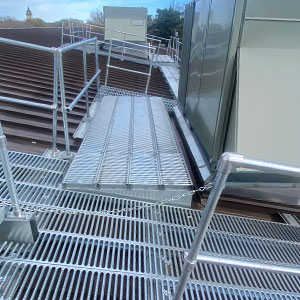
Metal building roofs are rarely flat. Even modest pitch affects how the walkway planks sit and how foot traffic load is distributed. GrateSafe® can be ordered with pitch-corrected supports for perpendicular runs, keeping the walking surface level even on sloped panels.
Before ordering, note the roof slope and flag any runs that cross the slope rather than running parallel to it. Those perpendicular runs are where pitch correction matters most. Skipping it results in an angled walking surface that creates both a slip risk and uneven load distribution on the roof panels below.
✅ 4: Align the Walkway to Your Access Point
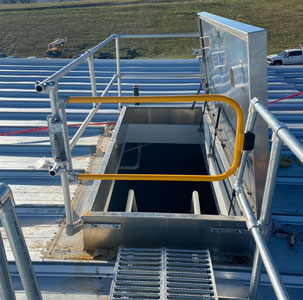
The walkway should begin at the point of entry, whether that’s a roof hatch, an access ladder, or a parapet gate. A system that starts mid-roof forces workers to traverse an unprotected surface just to reach the walkway, which defeats its purpose entirely.
GrateSafe® can be ordered with a swinging access gate at entry points, providing a clean, OSHA-compatible transition from the hatch or ladder to the walkway surface. If the access point has a lip or curb, account for that in your layout as well. A platform section may be needed to bridge the gap.
✅ 5: Determine Whether Guardrail Is Required
Not every rooftop walkway requires guardrail, but many do, and misreading the requirement is an OSHA citation waiting to happen. The two standards most relevant to rooftop work are OSHA 1910 (general industry) and OSHA 1926 (construction), and they apply differently depending on the work being performed on the roof.
Key triggers for guardrail include proximity to roof edges and unprotected sides or holes. GrateSafe® guardrail is OSHA-compliant and can be applied to one or both sides of the walkway. Confirm with your safety plan or the building owner’s facilities team which standard applies before finalizing the order.
GrateSafe® also offers a 14 GA toe kick (6” high) as an ordering option, required in some applications where tools or materials could slide off the walkway edge.
Get It Right • Before You Get on the Roof
GrateSafe® is built for fast installation. All mounting hardware is included, CAD drawings ship with every order, and R&S offers design assistance for complex layouts. As a purpose-built roof walkway for metal roofs, the system is available in galvanized steel or aluminum, with walkway widths in 12” increments (24”, 36”, and 48”) and custom plank lengths up to 12’.
But the fastest installs still start with a solid plan. Run through these five checks before you spec the system, and you’ll avoid the callbacks that cost time and credibility on the job, whether it’s a simple roof walk or a full roof catwalk across a large commercial metal building.
GrateSafe® Roof Walkway – Details Download:
Ready to spec GrateSafe® for your next project? Get a roof walk quote today.


